How Roof Material and Age Can Affect Insurance Before a Boca Raton Home Sale
September 3, 2026
September 3, 2026
Ask five Boca Raton homeowners how old a roof can get before insurance becomes a problem, and you will get five different numbers. Twenty years. Twenty-five. Forty, if their neighbor just switched carriers. All five might be right, and all five might be describing a completely different roof.
The age threshold depends in part on the type of roof. In Boca Raton, where the housing stock runs heavy on the Mediterranean look Addison Mizner set in motion a century ago, the number that actually matters at underwriting is not the year a home was built. It is what is covering it. A concrete barrel tile roof and an asphalt shingle roof age on two entirely different clocks, and Citizens Property Insurance writes that difference directly into its rules. Get the material wrong when you are pricing a listing timeline, and a home that looks perfectly sellable on paper can stall at the underwriting desk weeks before closing.
The instinct is simple: older house, older systems, harder to insure. For electrical panels and plumbing, that instinct holds up fine. For roofs, it only tells half the story.
Citizens, the state-backed insurer of last resort that a meaningful share of Palm Beach County homeowners end up carrying, requires a four-point inspection covering roof, electrical, plumbing, and HVAC on any new personal-lines application for a home more than 20 years old. That threshold applies regardless of what the roof is made of. But once you get past the four-point and into the roof itself, the rules split.
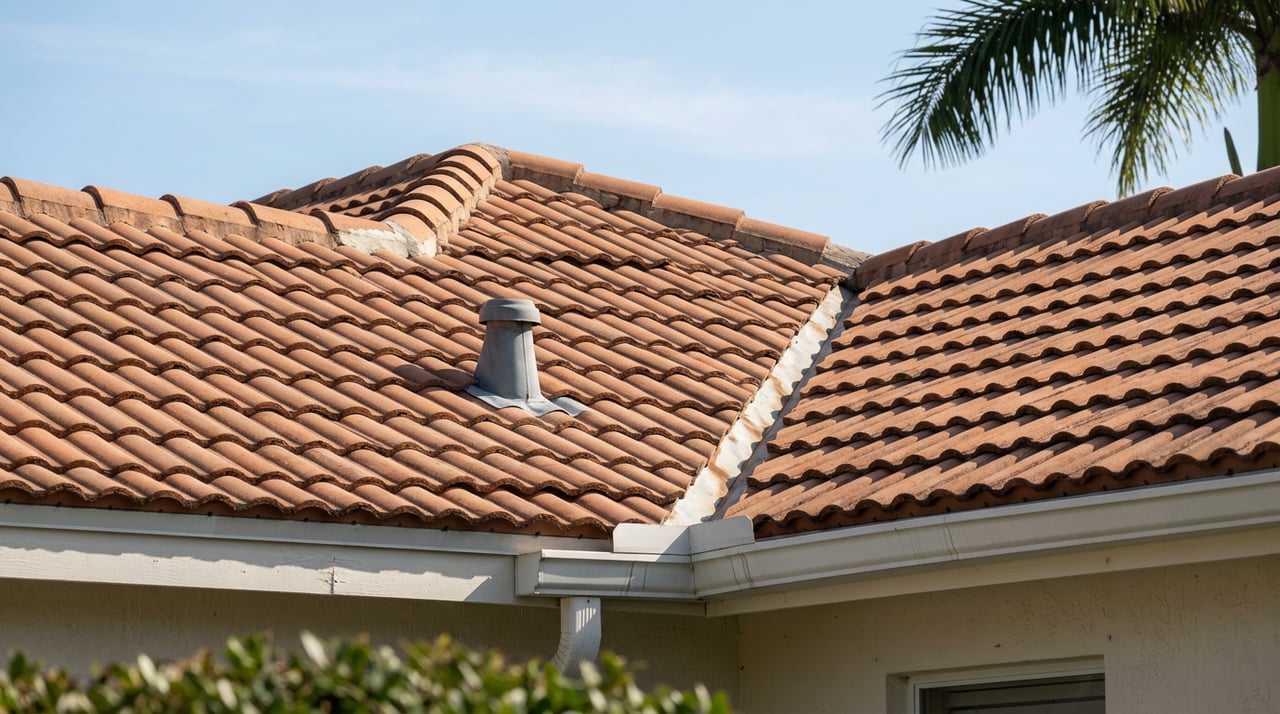
Citizens treats what it calls soft roofs and hard roofs on separate timelines. Asphalt shingle is a soft roof. Concrete tile, clay tile, slate, and metal are hard roofs. According to Citizens' current public inspection guidance, the gap between them is not small.
| Roof type | Citizens' age threshold | What kicks in past it |
|---|---|---|
| Soft (asphalt shingle) | 25 years | Certified inspection showing 5+ years of remaining useful life, or proof of full replacement |
| Hard (concrete/clay tile, slate, metal) | 50 years | Same requirement, on a clock twice as long |
That distinction matters when evaluating a Boca home's roof. A 45-year-old shingle roof has already blown past the point where Citizens will write a policy without documentation. A 45-year-old barrel tile roof still has five years before the same question even comes up.
Florida law adds a floor underneath both of those thresholds. According to Florida Pro Roofing, state statute prevents any insurer, not just Citizens, from refusing to renew a policy solely because a roof is under 15 years old. Between 15 and 25 years, the law requires a certified inspection confirming at least five years of remaining life to keep coverage in place. Past that, private carriers make their own calls.
Boca Raton is not a uniform city of one roof type, which is exactly what makes this worth understanding before you list. Camino Gardens, built in the 1960s on the former site of the Africa USA safari attraction, requires every one of its 430 homes to carry the same white barrel or flat tile roof color, an HOA mandate that has kept the material consistent for six decades. Royal Oak Hills, developed the same decade with roughly 400 homes, and Old Floresta, the city's first designated historic district dating to the 1920s Mizner era, both lean on the same clay and concrete tile tradition that defines the wider city, according to local roofer Mike McGilvary Roofing, whose family has repaired Boca tile roofs since 1974.
Boca Square is a different story. Built in the 1960s and 70s with no HOA and no architectural review board, homeowners there have had six decades of freedom to reroof with whatever material they wanted at each replacement cycle. Some of those homes carry tile. Some, especially after a storm-driven reroof, carry shingle. Neither choice is visible from the street listing photos, and neither shows up on a comp sheet. It only surfaces when an underwriter asks for the roof's age and material.
Newer country club communities have a related roof consideration. Neighborhoods like Woodfield, Boca Bath and Tennis, The Oaks, Les Jardins, and St. Andrews were built in the 1980s and 90s, still well inside tile's 50-year runway on paper, but old enough that the underlayment beneath the tile, not the tile itself, is starting to fail. That distinction matters because a passing four-point does not always mean a clean roof story. It means the visible systems checked out on the day of inspection.
Mike McGilvary Roofing's read on Boca's tile roofs is that the tile itself routinely outlives the roof around it. On most estate-scale tile roofs the company inspects, 60 to 80 percent of the material is still structurally sound decades after installation. What ages out first is the underlayment, the flashing at valleys and wall transitions, and the fasteners, especially on properties closer to the coast where salt air accelerates corrosion faster than it does further inland.
That is good news, but it also warrants careful review. It means a seller in a tile-roofed community is not automatically facing a full tear-off just because the roof has passed the 20 or 25-year mark. But it also means a seller who assumes tile equals no problem can get caught off guard by a failed inspection over a leaking valley they never noticed, even when the tile itself remains in good condition.
Planning ahead can make the process more predictable. A four-point inspection in Palm Beach County typically runs $125 to $300, and most inspectors will bundle it with a wind mitigation report in the same visit for a combined fee that beats scheduling two separate appointments. Getting that documentation before you list, not after an offer is already in hand, changes the entire negotiating position. A seller who already knows the roof's material, age, and remaining useful life can price and market accordingly. If roof details come up during the buyer's inspection period, a repair credit request may arrive days before a scheduled closing.
This matters most in exactly the neighborhoods where the informal replacement history is hardest to pin down: the no-HOA legacy tracts like Boca Square, where there is no architectural committee keeping records of what went on the roof and when. If you inherited the home, bought it more than a decade ago, or simply never kept the paperwork from a past reroof, that documentation gap is worth addressing before a buyer's inspector reviews the roof.
Does a partial repair reset a roof's insurance age? Ask your carrier how it treats partial repairs.
Can I still sell if my roof fails the four-point? Yes, but expect the buyer's lender or insurance agent to request a repair credit, an escrow holdback, or proof of replacement before the loan can fund. Getting ahead of it before listing avoids that conversation happening under a closing deadline.
Is a four-point inspection the same as a full home inspection a buyer orders? No. The four-point covers only roof, electrical, plumbing, and HVAC, and it exists purely to determine insurance eligibility. A buyer's full inspection is broader and serves a different purpose, though many Boca inspectors will perform both in the same visit.
Does this apply the same way to every insurance carrier, not just Citizens? No. Citizens publishes its thresholds clearly, but private carriers set their own age triggers, and those numbers have moved as the Florida insurance market has shifted through 2026. The safest move is confirming your specific carrier's rule with an agent rather than assuming Citizens' numbers apply across the board.
If you are weighing when to list a Boca Raton home built before 1990, the roof conversation is worth having before the sign goes in the yard, not after an accepted offer. Amie Calia works these details into every listing plan across Boca Raton's older neighborhoods, from Camino Gardens to Boca Square, so sellers walk into a contract already knowing what an underwriter is going to ask. Get Your Free Home Valuation and start that conversation before it becomes a deadline.
This article is general information, not legal, tax or financial advice. Consult a qualified professional about your situation.
Stay up to date on the latest real estate trends.

Get assistance in determining current property value, crafting a competitive offer, writing and negotiating a contract, and much more. Let me guide you through your home-buying journey.